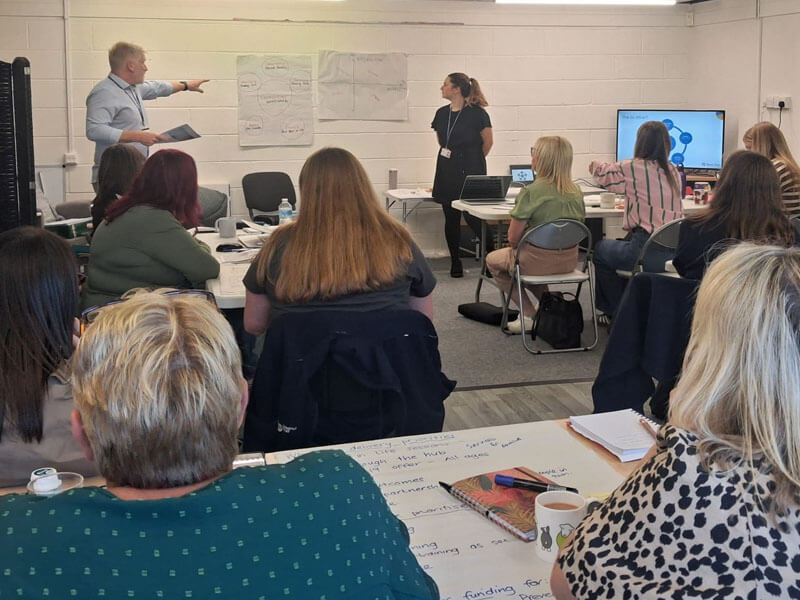
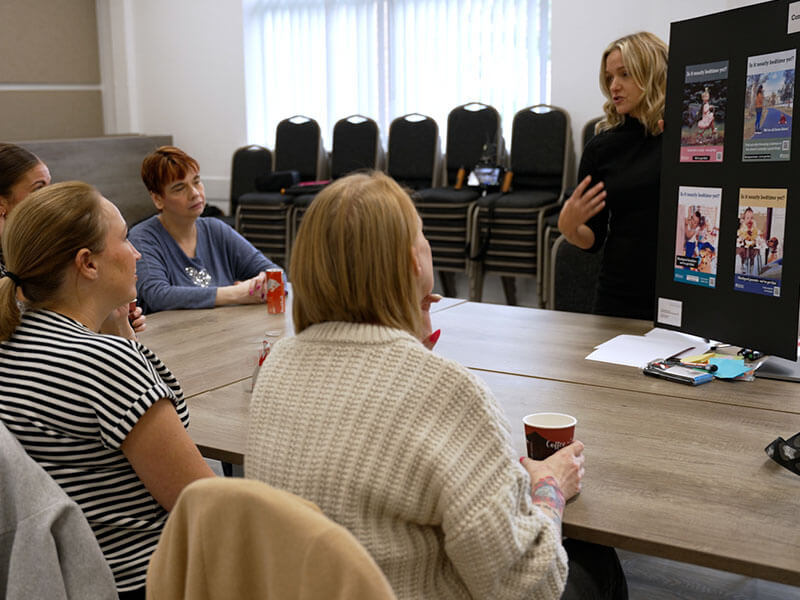
We were recently invited to present at a webinar hosted by Place Matters, as part of a series that explores the Department for Education’s new Best Start in Life Match Fund, to share our long term expertise of acting as a backbone organisation to a local authority.
The new opportunity will match a portion of the Best Start in Life and Family Hubs transformation money with external funding. This provides the opportunity to engage with a ‘backbone’ organisation, who will provide expertise in building and scaling collaborative partnerships and implementing impact models.
This series is aiming to help Local Authorities understand what place-based collaborative working looks like, the difference it can make and what it requires from them to create a genuine partnership.
I was happy to share, alongside my colleague Vicki Morgan, Senior Development Manager, a candid account of what we have learnt from over a decade of bringing people together and focusing on shared outcomes – acting as the engine room of early years system change in Blackpool.
At the webinar, we wanted to move beyond talking about individual programmes and interventions. Instead, we focused on what sits behind successful place-based change: the relationships, trust, challenge, community voice and partnership infrastructure that make lasting improvements possible.
When A Better Start began in Blackpool more than a decade ago, there was no shortage of committed professionals or organisations working to improve outcomes for babies, children and families. Across health, education, social care, public health, local government and the voluntary sector, people cared passionately about making a difference.
The challenge was never a lack of effort or good intentions. Rather, it was that organisations were often operating within their own structures, priorities and ways of working. We encountered a system full of expertise and dedication, but one that was often fragmented. Different services held different pieces of the puzzle, yet no single organisation held the whole answer.
Over time, we realised where we could bring most value was not delivering services directly but instead it was creating the conditions for effective collaboration and supporting partners to work towards shared outcomes.
Recently this role has often been described as a backbone organisation. During the webinar, we spoke about why, in Blackpool, we often refer to it as being the “engine room”.
For us, the term engine room better reflects the active nature of the role. It is not simply about holding partnerships together. It is about creating momentum, generating energy and maintaining focus on a shared vision.
That means bringing partners together, building trust, embedding community voice in decision-making, using data and evidence to inform action, creating opportunities for learning and supporting collective problem-solving. Much of this work happens behind the scenes. People often see the programmes and outcomes, but not the partnership infrastructure that makes those achievements possible.
One of the questions we are frequently asked is whether this role could simply be carried out by an existing organisation or service with the area. Our experience suggests that having an independent organisation dedicated to supporting collaboration brings significant advantages. Because our role was not to represent a single agency, we were able to act in service of the partnership as a whole.
Local authorities already carry enormous responsibilities, including leadership, commissioning, governance, statutory services and place stewardship. Expecting any one organisation to fulfil all of those responsibilities while also acting as a neutral partnership broker is incredibly challenging. Independence allowed us to concentrate on the collaboration itself, which is often the missing ingredient in system change.
Reflecting on how place-based working differs from traditional commissioning we talked about how it starts with relationships, shared understanding and community insight, rather than predefined solutions. It requires leaders who invest in trust, share power and embrace learning. These behaviours create the conditions for collaboration, shared ownership and meaningful, long-term system change.
As our work has evolved and we have supported other places to adopt similar approaches, we have continued to learn ourselves. Looking back, there are things we would do differently.
We would spend even more time building relationships at the outset. We would invest earlier in shared data and intelligence. We would strengthen community leadership from day one. Because relationships are a form of infrastructure. They require ongoing investment, attention and care if they are to support lasting change.
The national conversation around the Best Start in Life Match Fund is rightly exploring the value that backbone organisations can bring. Our experience in Blackpool strongly supports that thinking. However, what we have learned over the last decade is that places do not change simply because structures are put in place. They change when there is sufficient trust, momentum, energy and shared purpose to keep moving forward together.
Ultimately, the purpose of a backbone organisation, or engine room, is not to sustain itself. Its purpose is to make positive change possible. And perhaps the achievement we are proudest of is that organisations across Blackpool increasingly work together around shared outcomes for babies, children and families.
We were grateful for the chance to share our experiences and we fielded some great questions after presenting from the local authorities present. We love to talk about what makes a good place based programme, and are open to exploring those questions further with those looking to make changes.
Any questions? Get in touch at BetterStart@nspcc.org.uk and one of our team will reach out.